The dēvās took the puruṣa (puruṣa-1) as a fire-offering material and sacrificed him in the fire of Yajña and expanded it. At the same time, Vasanta (spring-season) became the Ghee, Grīṣma (summer-season) became the fuel stick, while the Śarad (moon-season) arranged the offering materials for the puruṣa (puruṣa-2).
Explanation:
Before embarking on stanza-6, we need to be thorough with the idea of two Puruṣas as explained in stanza-5. Let me summarize that aspect once more: Puruṣa-1 is the EVER existing background on whom occurs the drama of creation in the form of Puruṣa-2, the Jīva. In this stanza, they extend the story of creation and extol the splendors of the same with respect to Earth. Though Earth is an insignificant planet, in regard to the magnitude of size or age, it is very significant in regard to our own spiritual evolution and hence the vēdic hymns, though maintain a theme of describing Universal drama, also bring in the parallels to Earth – The Jaṃbū Dwīpa of purāṇa, every now and then. This stanza is one of those “Every now and then” moments.
This stanza has the following key points which need our immediate attention as they are used here for the first time:
Dēva – The angels
Yajña – The Sacrifice
Ṛtū (Ritu) – The Seasons
These three form three pillars of this stanza and few of the coming ones. First let us know each of them, one by one, and then dive to see where these terms fit in our explanation of this stanza.
DĒVA:
The word “Dēva” comes from the root word “Dyu”, which means LIGHT. So, Dēva is that which is embodied as the very LIGHT. This LIGHT is not the light we see, but the light which supports the existence. That is how scriptures describe. Our visible light is just 3/4th of the totality of LIGHT (ref:: Stanza-3). Who are these dēvas actually and what is their role? Dēvas are the limbs of Puruṣa or vivid emanations of Puruṣa. This fact is defined elsewhere. That is why one should understand Vēda as a whole and not by-parts. Where is it told that Dēvās are his different limbs or emanations, you may ask? In “Asya Vāmīya Sukta” 46th stanza:
Meaning is: HE (Puruṣa) is the one who is known by many names like Indra, Mitra, Varuṇa of the lower regions. He is none other than the divine eagle-God having majestic wings on each side – Suparṇa. His ONE-existence was described in so many numerous ways by brāhmins (Those who realized BRAHMAN). They also named him to be Agni, Yama and Mātariśva
Now, in this and only in this framework of definition will we use the word Dēva. So, a Dēva is “a particular aspect of FUNCTION-ing of Puruṣa”. When Puruṣa was ONE, these dēvās were in him as verily him-self. Just like our hands are verily us when in sleep or when not using them. The moment creation needed to be created, HE awoke, which means, Dēvās awoke too. Just like we realize we have hands when we need them to do a work, HE realized the Dēvā’s existence as soon as he desired to create.
So, Dēvās are the first beings to be “created” or rather “awakened” into consciousness. What are the characteristics of Dēvās? Do they have individuality like us?? NO. They are very different from us. Let me spend some time in explaining their nature.
Nature of the Dēvās:
They are very peculiar in the sense that there is no localization for them. Say you are hungry and I am hungry. The hunger is called “Vaișvānara Agni” or “Jaṭhara Agni”. This dēva is in you as well as me, and that is why, we feel the hunger. Now if I ask you, are there two angels of hunger or one? What would you say? The answer to this question forms the very basic understanding as to how dēvās permeate and localize.
Any function that you see in the cosmos is given a name and that name corresponds to the ” dēva-consciousness at work”.
Do they have an ego i.e., do they feel ” I am Indra and so I need to do this….” etc.,? Not at all. The very EGO which we understand is a dēva (called Indra – lord of Indriyas/organs; as EGO controls the organs). So, the dēvās themselves do not have any ego. Does you hand has a separate ego from you? Its the same scenario. The Puruṣa’s WILL works as the “functional aspect” of the dēvās.
WE, as humans, are product of millions of dēvās at work. That is why they say our body is not ours nor our mind nor our WORD and hence we need to keep it pious, just like we keep a rented house neat and clean. Then where are we or what are we? WE are verily the Puruṣa-1, hovered and covered by different combination of dēvās which results in “US – The I AM so and so -ness”, which is the Puruṣa-2. It is akin to a cloth. A cloth has many strings. Strip of strings and there is no cloth (or that which permeated cloth existed all the while).
I hope you are now clear in understanding who dēvās are. Let us proceed further.
Yajña:
Yajña means “Sacrifice” in its true sense. One must know the difference between sacrifice and charity or donation. Mere giving off something is no sacrifice. A sacrifice has the following elements:
— To Give or DO something
— No selfish motive
— To follow the DHARMA.
Only when the above three are followed, it is called a “Yajña”. One may ask what is DHARMA? It is that principle which resonates with the plan of creation. It in itself is another topic of discussion, but if one goes through instructions of Gita or Patanjali, with a proper guidance, one can understand what DHARMA is. It is necessary because, one might do a thing with no motive or not being selfish – like stepping on an ant and yet, it does not make that act, like stepping on ant, a Yajña. Because it has no DHARMA in it i.e., one could have been careful while walking, but they were “Ignorant/Lethargic/with an attitude of din’t care”. That is not dharma. DHARMA asks us to “CARE”. CARE is different from expectation. See how subtle the concepts are!! That is why its a path on razors edge, to understand scriptures. One small mistake can lead into weird understandings and push us into square one, on the path of evolution.
The fire sacrifices which we often see, forms only one part of the whole scheme of Yajña. It enacts the drama of the Universal Yajña i.e., the sacrifice happening in cosmos (just like the one mentioned in this stanza) and initiates the doer of Yajña into its secrets. (Unfortunately, only the skeleton of fire ritual is often seen by the people). So in conclusion, a Yajña is a sacrifice undertaken which results in blooming of the subject of the sacrifice into higher awareness of GOD-Consciousness. Example(s): Aśvamēdha Yāga, Manuṣya Mēdha Yāga, Sōma Yāga etc. Yāga or Yajña means the same.
Ṛtu:
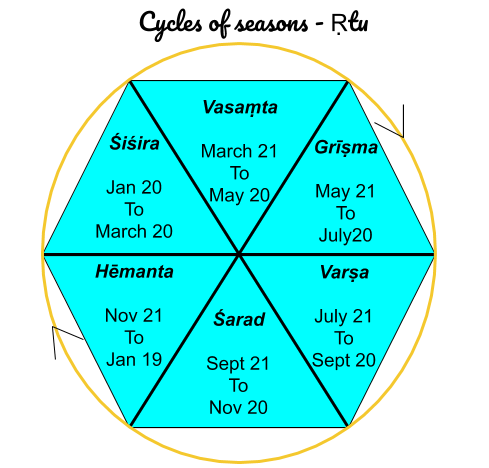
The seasons according to Hindu terminology are six. They are called Ritu or precisely ṚTU. That which repeats itself periodically on its own, is called a ṚTU. The word is derived from ṚTAṂ – meaning, the absolute reality behind the TRUTH or Sublime TRUTH. The sublime truth here, is that the Earth undergoes a transformation from season to season, expressing the many splendors of GOD periodically. Let us see what these seasons and splendors are (dates can be seen in the picture):
Vasanta: The season of SPRING. Most of the Indian calendars start with the advent of this season. That is why it is first of the cyclic seasons mentioned here. In this season, plants flower and it is as if the whole nature blushes with joy.
Grīṣma: This is the summers and the heat hardens the soft barks of trees making them potential fuel.
Varṣa: This is the rainy season and the waters of the heavens are brought down to the Earth. This of course mixes the mud and water – a combination for the origin of LIFE.
Śarad: The harvest season. It is in this season that the crops are ready to give food for the farmer who has been growing them since other seasons. It is in this season that we see clear moon. The muddy waters become pure as the mud goes deeper and the pure water rises higher.
Hēmanta: The snow season.
Śiśira: The Autumn season which sheds the leaves, to only give rise to new leaves and a start of new cycle in an old fashion.
Many poets of the world have discovered the vivid beauties of the seasons. It is a fact that the SUN rise has different shades of Aruṇa/Orange in every season. Not only the visbile beauty, but the functional beauty is also to be appreciated. That is what this stanza is doing.
Now that we have had a basic foundation on the terms used in this stanza, let us proceed to understand each line.
Ya tpuruṣēṇa haviṣā – dēvā yajña matanvatā:
The dēvās sacrificed the Puruṣa-1 into the formula of “Yajña”. “Havis” means fire-offering. What does it mean? How can dēvās who has no mind of their own, sacrifice Puruṣa-1, who is immutable? Is Vēda contradicting its own exposition? No. The way to understand it is as follows:
When Puruṣa-1 got an impulse to create, he awakened the dēva consciousness.
But, when dēvās awoke, they already saw a plan being worked out without their existence. This is the mind-plan of the GOD. The story of Brahma’s birth and the suggestion of Nārāyaṇa to Brahma to follow the creational plan from earlier kalpas is an expansion of this line of Puruṣa Sūkta.
Because the birth of cosmos is cyclic, there is not starting point and hence dēvās realized that a plan already exists.
They took this plan and found themselves some job to do! It is not their “desire” but they are compelled to do so. Just like a new born baby cries, even though it does not know what it means, the dēvās too are compelled.
Now, to create, you need a substance – Mūla Prakṛti as it is called. Before creation only Puruṣa and his dēvas were there. So, they took him as the object of sacrifice. What does that mean? They took him as the base with which they are going to etch and mold the creation into existence.
How is this a sacrifice? Because Puruṣa-1 did not intend nor did the dēvās, and the act resulted in creation from which Puruṣa/dēvās get nothing and because it follows the already existing DHARMA (from previous cycles of creation), it is truly a YAJÑA.
“Atanvata” means to expand. So, they expanded this formula of sacrifice into many other things and the result is the visible marvelous creation-Puruṣa-2.
As soon as the dēvās started the Yajña, the seasons too started to work as follows:
Vasanta/Spring:Acted as Ghee. Ghee means clarified butter which enriches the combustion process in a fire ritual. Vasanta is the season when everything blooms. This blooming aspect expresses the fire of life that is within the living organism. GHEE also does the same, it expresses the dull fire vibrantly, when poured onto a burning stick. So, the Dēvās sacrifice resulted in that aspect on Earth which expresses the fire of LIFE.
Grīṣma/Summer: To undertake a fire ritual you need fuel sticks. It seems that summers are acting as the fuel stick. “Idhma” means fuel stick. During summers, the dryness kicks in and the wood is hardened. The waters evaporate from Earth, only to shower and thunder later, else where. Due to these kind of properties, this season is said to be acting like the fuel agent for fire ritual i.e., the source of energy.
Śarad/Harvest:In a fire ritual, along with wood and oil, you also need an offering material. It seems that the season of harvest offers the FOOD materials which are offered into the fire ritual.
Here, fire is synonymous to Grand-LIFE. So, the fire-ritual is that sacrifice of the dēvās which results in multiplication of LIFE element. So, the summers offer the energy while the spring offers the oils, the harvest offers the food materials which are sacrificed into the cycle Ritual of YEAR-cycle. The seeds of harvest are again sown and the cycle repeats. This sowing of seeds forms part of the ritual. Just as in our mundane rituals, where we offer something to god and take it and distribute it, the dēvās are taking his own creation, multiplying it through seasons and offering to him again!
This in summary is the essence of 6th stanza
SIDE NOTES:
CAUTION: Terminology of Dēvas used in the Vēda are different from those used in Purāṇa, though some of the names are same. In purāṇās, the dēvās have ego, etc., only to show the map to our psychological scheme. They elaborate on seed principles of the Vēda. Example: Vishṇu of Vēda is an all pervading Puruṣa, while the viṣṇu of purāṇa is one of the holy-trinity who sustains the existence. Viṣṇu of the Vēda is equivalent to “Sri Maha Viṣṇu or Maha Narāyaṇa” of Purāṇa. This distinction is very necessary for proper understanding.
Vēdās have special hymns with very specific purposeful calendars with the start of each season. For example, this purusha sukta has the calendar that starts with VASANTA as first season (which is widely known to us) representing the marvels of EARTH’s bloom. Similarly there are other hymns which have, say Grīṣma as their starting season, or Hēmanta as starting season, for some other purposes.