
The puruṣa who occupies three regions of subjectivity, is sprouting into the fourth region of objectivity. Again he sprouts into the organic, inorganics substance. And yet again, he pervades all the directions.
This stanza packs the clues as to “in what way” this cosmic man enters into his creation.
Tripāda = The puruṣa who has three feet. What are the three feet? Pāda, here represents the “stage or part” of the stanza-3. So, three parts of the four parts is meant here. The Puruṣa with three immortal parts is the subject of this line. It seems that this Puruṣa has taken birth or spout – Udait, upwards – Ūrdwa. What does it mean by upward here? Upward implies into the “subtle planes“.
When we stand upright on Earth, we point our heads to SUN. Well, of course I mean during the noon and as seen from equator, because, NOON represents our complete wakeful state (if midnight is deep sleep) and Equator is the more fruitful zone on Earth and hence represents the ability in us to manifest and understand all ideas. So, on a noon and on Equator, we point our heads to SUN an dfeet to ground. So, the upward direction is into “The LIGHT” which “caused” the creation. We extol this in hymn of”Āditya Hṛdayaṃ” as well. So, it is said that Puruṣa is sprouting upward into the planes of immortality of LIGHT. That is why as we go upward, away from Earth, we see the density of matter reduces (air reduces into space) and what we are left with is the SPACE pervaded by Puruṣa (the base background of quantum fluctuation, if you allow me to call it so). That is why, the path of “Kundalini”, when a spiritualist elevates himself in YOGA, is “UPWARDS/Ūrdhwa”.
Now, is there a “growth” to this part of his creation? or Does he grow in this three feet world? NO. Because it is “Amṛta”, it can NOT CHANGE and hence, the Puruṣa is fixed in the 3/4th of his creation. It is immutable. The concept itself does not exist in that world or plane of existence. In a way, we can call this as HE takes roots in the immortal planes, as roots symbolize stability and support.
It seems that the remaining part, the 1 pāda, is manifesting as the “Iha Lōka” or the material world which we perceive with our natural instruments of senses+mind. What is the difference between 3rd and 4rth stanza? 3rd stanza shows us a blueprint of HIS creation being divided into 1:4 and 3:4 ratio, while the 4th stanza shows how he brings these 3/4ths and 1/4th into life by his “way of pervasion”. So, he took roots in the 3/4ths of his creation of immortal planes and now, pervades the manifested or objective creation. “Iha + Bhava” implies that all that we see is his manifesting as Objective creation. Does he grow in this plane? YES of course! That is what we see all around. So, he expands and pervades the whole of visible creation.
Take the blue highlighted statements together now:
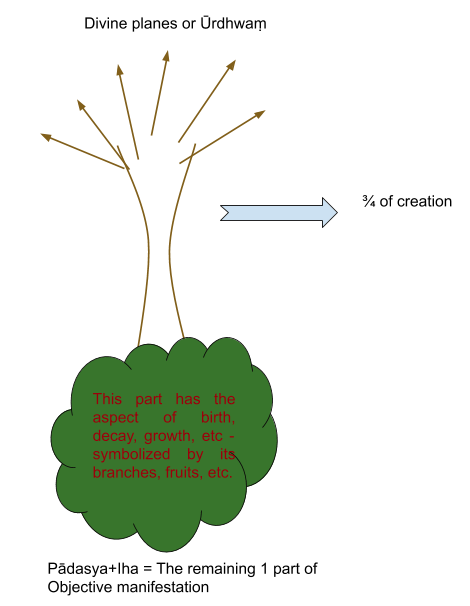
What do you see? You see a symbolic TREE with its ROOTS in teh space and branches on the ground. This is what Gīta or vēda calls “Aśwatta Vṛkṣa – The inverted TREE“. So, the first two lines of this stanza explains us about this ancient inverted tree of Aśwatta.
Punah means, yet again. So, yet again, after pervading the physical globe of space, Puruṣa enters into the Sāśana – Organic and the Anaśana – Inorganic.
The Puruṣa entering into these two kinds of materials implies the division of the physical creation into two parts – Which form a base of life and which consume this base and multiply over time. Thus, the whole aspect of LIFE is simply summarised here, ranging from atoms to cosmos. Not only did he enter and pervaded these organic and inorganic substances, but Puruṣa Exceeded them – Vyakrāmat. Exceeded implies that not only does “he exist in them”, but, “they also exist in him”. This is the concept with which Viṣṇu sahasra Nāma starts with – ” Viṣvaṃ Viṣṇuhu …”.
So, this 4th stanza suggests that he enters into the immortal planes, take roots there, and grows into the physical world by energising the life on Objective planes. The key of word “Punah” suggests that this happens on all levels and at all times!