
Hi Friends, in today’s article, let us explore the nature of death via the Kaṭha Upaniṣad, which is hailed as an epitome of all the esoteric teachings in regard to the nature of death. In fact, the Upaniṣad has a very peculiar appeal to the reader by the way of the story of Nacikēta’s tutelage under the guidance of lord Yama (god of death).
Upaniṣad:
In one of my earlier articles: 5) Vedic mysticism and Indian Trinity we have briefly seen what Upaniṣad means. Let us recap the main gist and add some finer points here. Upaniṣad is part of the Vēda. The word Vēda is different from a book of Vēda. Just like Science is different from a textual collection of few laws of nature, Vēda is also different from the collection of hymns (which are Saṃhitās). Then, what is Vēda? It is the wisdom of ONENESS – the oneness of Universe, the oneness of body-mind-soul, the oneness of all that is. To become this oneness, Vēdic texts guide us. To help us understand this guide and the intended language of the Vēdic seers, Upaniṣads were introduced. Upa+Aniṣad = That which takes us closer. Closer to what? To the Vēda/wisdom of Vēda of-course, as they are part of the Vēda itself. Every Vēda has its own set of Upaniṣads to guide us appropriately. More in-depth understanding can be found at: 23) The Vedas.
Ka-ṭha (क-ठ):
As a kid, I used to read the title of this Upaniṣad as “Katha Upanishad” where, in Telugu, Katha = Story. So, I used to think this as an Upaniṣad of a story (LOL). As I grew up, I realized it was not Katha, but Kaṭha. I never knew the meaning of Kaṭha until the spiritual aspects started to blossom in my life. I like the hints given by two eminent saintly gurus – Master. E. K and Sri Sivananda Murthy. I am summarizing the essence in the following.
There are two ways to look at this word “Kaṭha (कठ)”:
1) To study the Vēda, there are different “schools” that existed in the past (some of which still exist now also). A school here, means an approach. These schools were called “Śākhās“. There are umpteen approaches to the Vēda (wisdom is ONE but the manifestation is infinite!). One of those approaches/schools of studying the Vēda is “ Kāṭhaka Śākha “. Others, for example are:
- Śatapatha – Path of 100 (infinite) Steps
- Gōpatha – Path of Lights (Gō=Lights)
- Taittirīya – Path of Assimilation (Tittiri Bird = power to assimilate: 52) Introduction to Taittirīya Upaniṣad)
- Aitarēya – Path of Objectification
- etc.
Now, what does Kāṭhaka approach signify? It incorporates in it, the following set of points at every step:
- Primary goal of this approach is to introduce us to the Lord of DEATH or more precisely, “Lord of Limitation”. Yama means limitation. This approach to the Vēda first shows us the nature of this limited world and allows us to befriend Lord Yama.
- One of the main symbols of this approach is DEATH/Limitation. Taking the symbol of death in a story form or a parable form, this approach lets us see the reality of life-limited. Death and Lord of Death are like characteristic elements of this Kāṭhaka Śākha.
- A primary thumb-rule that this approach highlights to us is that, we have to reach lord YAMA when in this body, but not after leaving the body. If we can cut through the symbolic veil of the scriptures of this genre (Kāṭhaka), we will surely see that YAMA is to be realized when a person is alive but not when a person looses his body. So, having a physical body is primary requirement to get trained in the wisdom path of crossing the limitations of the mundane.
2) The other way to look at the word “Ka-ṭha (क-ठ)” is by considering the following table. The following table shows different centers (chakrās) which when awakened, act as lotuses and the syllables associated with each petal. Each syllable (Akṣara) represents a form of the indestructive aspect of the ONE lord. A syllable or set of syllables associated with a chakra imply that when that chakra is awakened into a lotus, those syllables or the powers of those syllables blossom and cut the associated limitations in us. (for more details, please read: 54) Beauty of concept of a Mantra).
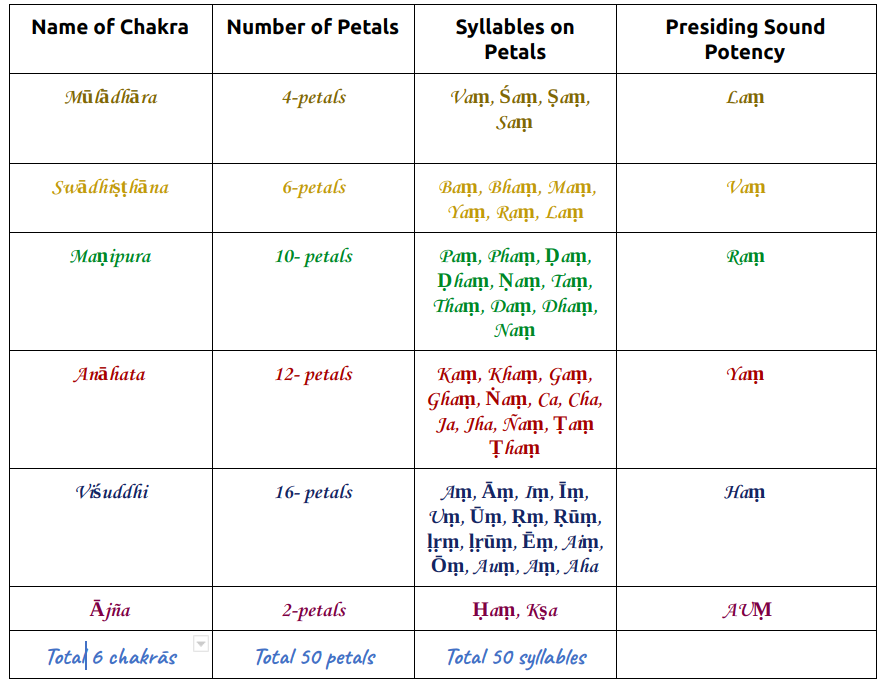
Note the syllables of fourth row: “Heart Lotus or Anāhatha Chakra with 12 petals” – “Ka-Kha-Ga-……..-Ṭha“. Thus, there are 12 syllables from Ka to Ṭha. Heart center is where the Lord in us exists, is the primary aphorism of any Vēdic statement (take Mantra Puṣpam or Āditya Hṛdayaṃ for example). 12 is symbolic SUN himself as it is said that there are 12 Ādityās (also, we perceive full effects of sun through the 12 months and 12 zodiac). The SUN (I AM-ness) in us exists at the heart center. When un-awakened, it exists as individuality where as when awakened, it exists as Universal SUN having its divine LIGHT reaching every nook and corner of all domains of Universe.
So, that Upaniṣad, which helps us unfold the 12 petals of the heart-lotus (Ka, Kha, Ga, …. Ṭha) and reveals the lord in us is called KaṬha-Upaniṣad.
Symbol in the story:
Overall, the story is as follows:
“…..King Vājaśravasa donates all things except his son Nachikēta. Then his Nachikēta asks three times to whom shall he be donated. To “God of Death” utters his father. SO, Nachikētas takes it seriously and goes to the abode of Yama, lord of death. He waits there for three nights, for which, three boons would be later sanctioned by lord Yama and also a bonus boon for his fitness in learning……..“
You may read the actual complete translation elsewhere – I prefer that of Sri Aurobindo’s. It is not possible for me to give a complete commentary of the whole Upaniṣad here (I am planning to write one in future, but far future it is!!). So, what I want to do here, is to give hints on few elements, which would help you weave a harmonious understanding when you decide to read the whole Upaniṣad/its commentary.
Redundant paradox – Ha / ह & King Vājaśravasa:
All along this Upaniṣad, you will notice a lot of usage of “Ha / ह”. One of the meanings of “Ha / ह = As you already know!”. The starting line of the Upaniṣad uses it as “uśan ha vai vājaśravasaḥ …..”, where the meaning would be “There existed a king named Vājaśravasa, as you already know”. How do we know in the beginning of a story? This is where, the KEY to Upaniṣad lies. It is trying to tell us that though this is the first time we are hearing the name of the king, he is most familiar to us. That is, to suggest that Vājaśravasa is the Omnipresent GOD, this technique is used. How can we confirm? Well, three things:
- His Ears are that of horse itseems – Vāja=horse and Śravasa=with the ears. Horse ears are symbolic to Haiagrīva, the lord Vishnu.
- The word “uśan” at the starting is the root word for “uśanaśa”, whom, Krishna calls himself as in Gīta.
- He could alone give permission for Nachikēta to go to abode of death, without which, he could not have gone. Thus, only authority beyond Yama, is lord himself.
These three points suggest the nature of king Vājaśravasa as that of Lord Omnipresence.
Guest = Soul & Yama’s abode=Body:
General thought is that, after one dies, one either goes to heaven or hell. Forget this thought right now, if you want to harmoniously understand Vēda. In fact, this Upaniṣad tells us quite a different and more natural hypothesis. The essence is as follows:
The Being/Jīva who enters a physical body when it is formed (as early as its unicellular level) is Nachikēta. Later in the Upaniṣad, it will be said that he is verily the FIRE or the fire of LIFE (Nacikētāgni). The body (physical as well as other spiritual bodies – sthūla and sūkṣma śarīra) is the limitation to this Universal fire i.e., it encapsulates an omni aspect into a limited bodily frame. Thus, BODY is the abode of lord of limitations, YAMA. So, the material and spiritual matrix in which the being dwells is the abode of YAMA, symbolized in later purāṇās as NARAKA/HELL.
With this key-mapping, it will be easier to see how, the king could give away his son to the lord of death. That means, the GOD allowed his emanation (son) to be embodied into the creation of limits!
The mystery of 3-Three (asks, nights and boons):
The number 3 occurs thrice which is very significant in this Upaniṣad. Understanding this, also affirms some of the finer points we explored just above. Let us see.
First instance:
Nachikēta asks thrice to his father, to whom he shall be given to. Why three times? His father also answers him only for the third time, but not at the second or first ask. Why? Creation happens in three stages God to – 1) Pure Consciousness; 2) Energy/Power and 3) Material creation. When the creation is in stage-1, GOD alone exists and no one else exists. This is the SUPREME state of existence. When this divides into GOD and Energy (Shiva and Shakti), then too, they too alone exist and no creation as such. So, when Nachikēta asked first time and second time, HE could not be given to YAMA, as there was no abode of YAMA as such! In third stage, when creation begins due to the interplay of consciousness and power, YAMA’s abode is ready and hence Nachikēta was given to him.
Second Instance:
Nachikēta waits three nights at the abode of YAMA. Only after waiting for three nights, will lord YAMA come and visit Nachikēta. While he was waiting, Nachikēta does not even eat anything. This is how the story goes. Do you find anything peculiar? Why 3 nights? Why not 3 days? Also, why 3?
As mentioned earlier, when a being is incorporated into the matrix of created body, it happens so in three stages. So, three NIGHTS imply that the creation is DARK to the created being up to three stages i.e., it has no awareness of its own when it passes in the planes of GOD-Consciousness-Power. This is like a sleep like state called “TAMAS”. Hence, symbolized as NIGHT and 3. The same is reason for his fasting/non-eating.
After the 3 nights, i.e., after the whole incorporation of soul into body has occurred in 3 stages, the soul awakens in the body and finds that it is limited by the body. In Reality, soul is universal. In practicality, as long as individual soul exists, it is conditioned by the body – like a water in a tumbler. This “perception of limitation” is the story of YAMA (lord of limitation) “Seeing or visiting” Nacikēta, after 3 nights.
Third Instance:
Due to the wait, Nacikēta will be awarded 3 boons by Yama i.e., each phase of creation involves LORD omnipresent teaching the budding soul, the art of existence in those planes. Who is YAMA? He is friend of Vājaśravasa. If you go deep into scripture, you will see that YAMA is also Lord Omnipresent (just like the king), but that mode of omnipresence, who came down as the “LAW of LIMITATION” to “Teach” the soul-Nacikēta. The boons have in them, the necessary keys to understand the descent of LORD and ascent of Being.
Guest:
It is said that Nachikēta was a guest to Yama’s abode. We all are guests into our bodies. We have lived many lives in many bodies and hence, with respect to Yama’s abode of limitation, we are but guests – we come and go. This is the primary secret in saying Nacikēta was a guest. Also, the guest is son of the LORD and hence, YAMA teaches the soul/being the art of FIRE or the flame of life!
At the end of the Upaniṣad, Nachikēta goes back to his father. In this way, Kaṭha Upaniṣad gives practical instructions of BODY to the SOUL as to how to utilize it to become and retrace the path to the father – GOD!
Conclusion:
If one follows the above keys that we explored, I am sure that you will look at Kaṭha Upaniṣad from a more death nature revealing point of view. Not only that, but one will also see many moral values like – respecting father’s wishes, attending to guests without any negligence, the dedication needed in learning a wisdom branch, the grace of a Guru, etc. The whole Upaniṣad is a package of unlimited wisdom to a truth seeker. I hope I was of some help to you. I tried to keep it as simple as possible, but the complexity of the topic lured me into some extra additions. Please let me know if you need any more clarifications in regard to this Upaniṣad or my exposition.
Thank You!