
Happy Independence day to my fellow Indians! We are cherishing the peaceful walks on soft booted feet because of the hard struggles of past generations’ patriots. Let us all move forward, in their memory, to uplift every one else including ourselves, giving some meaning for the un-witnessed and yet evident sacrifices of the past!
In today’s article, let me introduce to you all, the flavor of Taittirīya Upanishad. This upanishad is one of the very important upanishads in the upanishadic lore, for, it lays the very foundations of spiritual life in a budding soul. This was the first Upanishad taught in a Gurukula, once up on a time, when a kid is newly joined. Does that mean, it is for kids and not for adults? In this modern era, we are all kids in the field of self-analysis and self-learning and thus this Upanishad forms an inevitable syllabus in our earnest purist.
But, being voluminous, I chose to discuss few introductory points relating to the Upanishad and then the first few verses which give a five-fold bases that sustain the manifested creation. This sets us on right thinking lines when we dwell in the objective world of ever continuing interactions and lays a stable track for the journey into upanishad.
Upaniṣad:
What is an Upanishad? Most of the modern day scholars can give you a plethora of definitions. But scholars are not seers. Scholarly knowledge remains knowledge and never converts into wisdom. This is the reason for so many differences. When a wise seer utters a statement, it packs within itself a huge amounts of wisdom to be seeded in the contemplative mind. Such approach is what this blog is all about.
So let us understand the Upanishad as intended by seers. First of all, we should not seperately study upanishads. They need to be studied in conjunction with the Vēda. A separate outlook destroys the purpose. Every vēda has three sets of branches of wisdom associated with it. These three sets form three-dimensions of ONE wisdom.
- Brāhmaṇa – This expands (Bṛhmṇa = to expand)) the concepts discovered by vēdic seers and give different formulae pertaining to those aspects.
- Araṇyaka – This gives a stir to the latent consciousness in us and ignites that fire which consumes KNOWLDGE and gives out the light of Vēda/Wisdom. Araṇi – two polar opposite stones used to generate fire.
- Upanishad – This is our present topic.
Thus, we see the 3-D wisdom of Vēda. So, Upanishads, unlike popularly understood as relatively modern to Veda, are actually as ancient as Veda. Upanishad means that which takes you near. Near to what? Near to the Vēda. What is Vēda? It is verily yourself. Thus, Upanishad acts as a “guide or manual” to the Veda and helps us understand the concept of UNITY in diversified creation.
Taittirīya:
Depending on which branch of Vēda the Upanishad belongs to, the way of understanding, its keys, its total exposition changes. Present object of consideration – Taittirīya belongs to the Taittirīya Śākha of the Yajur Vēda. In 23) The Vedas, we have seen what each Vēda concerns itself with. Taittirīya branch of wisdom has a prequel which gives an overview as to how this name originated. Let us reserve that for some other time. For now, the important aspect to understand is that, Taittirīya is that branch of wisdom pertaining to the bird- Tittiri (kind of sparrow) which is symbolic for assimilating anything. To help a student, newly incoming, assimilate the whole education, Taittiriya branch of wisdom acts as a initial instruction manual and primary guiding torch. That work which epitomizes this fact is Taittirīya Upanishad. This has three sections, each named as VALLĪ:
- Śikṣā-Vallī: The manual for proper intonation, or rather, proper living in all its aspects.
- Ānanda-Vallī: The manual for our ascent, from the states of many into the state of pure bliss.
- Bhrigu-Vallī: The manual of Bhrigu – meaning the PURE white light => consciousness. This is an intermix of above two vallīs and establishes, once and for all, the ONE in us.
In this article we will be dealing with introductory part of Śikṣā-Valli.
- The key of Intonation:
- The five Adhikaraṇas – 5-fold bases
- The four elements of each base:
The Key of Intonation:
Om śīkṣāṃ vyākhyāsyāmah:
varṇah svarah – mātrā balaṃ,
sāma santānah ityuktah śīkṣādhyāyah.
The sages are saying that from here on, the instructions related to intonation (śīkṣā) are being taught. But when one properly go to to next stanzas, nothing more of the key of intonation is given. Then does it mean the Upanishad is faulty? You see, unlike modern day “textbooks”, vēdic books are not “complete”. First of all, it is an oral tradition. That which you see in print is but part of the whole truth. That is why many scholars are fighting with each other in regard to the missing links. You can get such links only through teachings of a GURU and those true gurus are rare which makes it all more complex.
Anyways, the seed principles of intonation are very clearly given in this stanza. The actual way of utterance is to be learnt from GURU – no other way! What are these seed principles?
Varṇa-Svarah: Meaning, each syllable to be uttered through vocals in a pitch. Varṇa means a syllable and svara means a sound potency. Thus, each syllable of the mantra has a pitch associated. Varying this pitch varies its meaning (and there by effects). Also, varṇa can imply COLOR. Thus, a link between color and sound is laid in this stanza. Rig Veda suggests that the birth place of varṇa and svara is ONE which is “Paramē Vyoman” – The Ultra Space. The space beyond visible space gives rise to the principle of LIGHT and SOUND. Both are waves, both are characterized by wavelengths, frequencies and velocities. This hidden relation between light and sound is brought by this mantra suggesting us to meditate the situation when both were one and the same. Vēda says that a true seer can listen the color and see the sound. This is the meaning of that cryptic statement!
Matrā-BalaṂ: The pronunciation, the stress of a syllable and its variants form another important aspect of key of intonation. Also, “Ma” implies to measure. The measure of each syllable – its duration of utterance or its weight in the word, when meditated upon unveils the strength of that syllable in the utterance. This, if not catered for, is lost in haphazard way of utterance. Also, one should gaurd (tra) this measures of intonation to give strength (balam) to the “way of intonation”.
Sāma-Santānah: Sāma means a kind of singing. When vēda is sung, it is called sāma style. Sāma also means breath – “Vāgēva Rigvēdah, Prāṇah Sāma Vēdah” says the Upanishad. So, when syllables are meditated upon as the LIGHT of the soul and uttered forth by catering to the rules of measures, what produces (santāna) is the SĀMA or the Prāṇa or the life force in us. This is the pure essence of this starting passage! IT thus gives the core essence of key of intonation which we explored in 28) The Six Keys (part-2).
They conclude by saying that this forms the basic tenets of Śikṣa – The key of intonation.
5-fold bases:
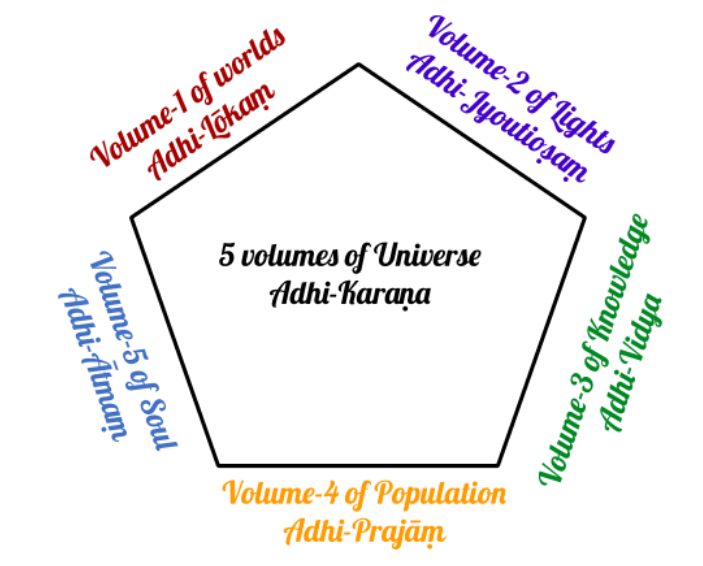
Then they go on to give us a proper way to look at the world around us. The seers ask us to imagine the world in 5 Volumes of a huge BOOK (of Universe) – Mahāsamhitā. These volumes are (in the following, adhi means a base or basis or foundation. Let us just call it volume for simplicity):
pañcasvadhikaraṇeṣu (5-volumes):
adhilōkaṃ, adhijyautiṣam, adhividyaṃ, adhiprajāṃ, adhyātmaṃ,
tā mahāsamhitā ityacaṣatē
- Adhi-Lōkaṃ: The volume of worlds. Here, world implies a plane of existence.
- Adhi-Jyoutiṣaṃ: The volume of Lights. Here, jyoutiṣa does not mean “predictive astrology” but implies the true wisdom of lights as extolled in vēda.
- Adhi-Vidya: The volume of Knowledge. Vidya means an art of education. The end result is knowledge and application of knowledge yields wisdom.
- Adhi-Prajāṃ: The volume of population. Here praja means pra+ja – that which is born in a special manner i.e., the wonder of birth of anything.
- Adhi-Ātma: The volume of Soul. Ātma does not mean something that is not body, but Ātma means that UNIT existence of “Self including body”. This is clearly mentioned in later part pf this Upanishad.
Each volume is made up of:
- Cover-page (pūrva rūpaṃ = starting point),
- Ending page (Uttara rūpaṃ = the final point),
- Intervening pages (sandhi = that which relates the both states) and
- Content of the volume (sandhānaṃ = that which binds this relation).
Thus, each of the 5 volumes has 4-elements associated with it. From the starting point, via the help of interlinking links, we should reach the end point. This journey forms the content of this volume! Understanding these 5 volumes in this way gives us “complete key” to understanding the manifested creation. Let us go one by one:

Volume-1: Of Worlds:
athādhilōkaṃ:
pṛthivi pūrvarūpaṃ – dyauruttara rūpaṃ
ākāśh sandhih – vāyuh sandhānaṃ
ityadhilokam.
Now the seers are starting the description of volume one. It seems that the volume of worlds is made of
- First cover page as Pṛthvi: What is Pṛthivi? This is the material existence that we see. The moment “lōka” is uttered, it means a plane of existence rather than a globe of planet. That which coagulates into particular perceivable form is called “Pṛthvi”. It seems that this is the starting point for our observation. Once we have thoroughly contemplated this cover-page, we aim at going to the end-page or final goal.
- End page as DYAU: “DYAU” is the root word for many later words like Dēva, Dyumān, Dyumatsēna, etc. It implies “plane of origin of lights“. This is often wrongly translated as SKY/Space/heavens. But that is not so. Later, it will be said that that which links these both is SPACE/Ākāśa. When you look at the dark space, we see nothing. But from that apparent nothing something keeps coming. The origin or birth place of that something is a plane of existence in itself and is called DYAU which is also known by the name “Svar Lōka or Suvar Lōka”. How to reach an understanding of this?
- Juncture as Ākāśa: It seems that we can understand DYAU only with the help of Ākāśa or visible space. The visible space/Ākāśa permeates the whole creation and yet it originates from something (DYAU). This twisty thought needs more meditation than analysis. How to mediate?
- Bonding via Vāyu: It seems that the air we breath helps us. In fact vāyu does not mean air, but pulsation which exists in and around us. Universe pulsates, we pulsate. An effect of pulsation is breath and breathing is possible because air too pulsates (contracts and expands).
Thus, by standing on Earth or material frame of reference, when we observe the principle of pulsation via breath, we travel via visible spaces into planes of origins of lights. That is where the TRUE “I AM” exists. This is the lesson of Volume-1. Because, starting from Earth till space beyond, everything are many planes of existences, this volume is called volume of WORLDS.
Volume-2: Of Lights:
athādhijyautiṣam
agnih pūrvarūpam – āditya uttararūpam,
āpah sandhih – vaidyutah sandhānam
ityadhijyautiṣam.
Now the seers are describing the volume-2. It seems that this is volume of lights (not astrology, lights) and is made of:
- First cover page as Agni: What is Agni? “Angānām nihitaha Agnihi” is the definition of agni, meaning, that which resides at every nook and corner of our body (or universe). So, agni is a permeating agent (like vishnu, infact they are same – more on that else where) which exists either dormantly or actively at any location of this Universe. The most visible form of it is the FLAME of Agni which we call fire. SO, the seer is asking us to start at the most visible form of AGNI as the starting point of our contemplation. What is the goal?
- End page as Āditya: Āditya = Offspring of Aditi. Aditi=that which has no end/begenning i.e., eternal. So, Āditya is the spore of SUN that periodically germinates in the visible space through the womb of eternal aspect-ADITI. This Āditya, the emerged “soul” of SUN is the true representative of our soul – sūryāntarvarti. Thus, naturally the goal is to reach Āditya (as defined here – not the solar globe). But how?
- Juncture as Āpas: Āpas=waters of creation. More can be seen in Mystic Passages 4: Nāsadīya Sūkta – Hymn of Creation (part-1). āpas are the waters that exist in the universe as life-element. Their gross projection is the water that we have on Earth. SO, āpas is just the subtle form of water and acts exactly as water acts on a seed to sprout. Āpas nurtures our inner-self to sprout into wisdom of Āditya. But how to get hold of this link-Āpas?
- Bonding via Vidyut: Vidyut = Fire of Electricity. It is through the electric fire we need to grab hold of the aforementioned link. Is it not dangerous? Well, they are not asking us to hang on a transformer or ski on electric wires. They are asking us to contemplate and control the “Vidyut” in us. This is done via many yōgic practices. Our body is full of these signals going up and down along the spinal column. The central current-Kundalini is the key. Thus, if we can get hold on it, we can unveil the lessons taught in this volume.
So, by taking the visible fire as startying point, our goal is to reach the inner soul-Āditya (who radiates the fire we saw earlier) via the connecting agent of life-force through the steering wheel of Electric fire. This is the lesson of second volume. Because starting from fire, to inner-SUN, everything is made of lights, this volume is called volume of LIGHTS.
Volume-3: Of Knowledge:
athadhividyaṃ
ācāryah pūrvarūpam – antēvāsyuttararūpam
vidya sandhih – pravacanaṃ sandhānaṃ
ityadhividyam.
Now the seers are describing the volume-3. It seems that this is volume of knowledge and is made of:
- First cover page as Ācārya: The one who teaches is Ācārya. This need not be ahuman, but anything that can teach us. A tree, a cow, an ocean, a human, etc., all can be our teachers. So, this is the starting point of this volume. What is the goal?
- End page as Antēvāsi: The goal is to become “Antēvāsi”. Who is an antēvāsi? A student who resides in the heart of a teacher is called antēvāsi(~antar+vasi). What does it mean? Doe sit mean a teacher favoring one student over the other? NO.W hen a student is genuine in their efforts to educate, they unconditionally shape into that disciple who takes a seat in the heart of the teacher. A mere name of that student will create tears of joy in that teacher, even after many years. Such aspect is being explained here. Esoterically, as we said anyone/anything can be a teacher. Then, our goal is to become the “content or soul” of that teacher (or thing). In-fact this again is the very definition of “I AM THAT”. So, this volume can be looked from normal student’s perspective as well as esoteric perspective. How to be so?
- Juncture as Vidya: The only way a student does justification to his studentship is via the education he is undergoing. This education is called VIDYA. It is not memorizing alone, but the art of VIDYA implies a state of awakening ones’ consciousness to the latent and hidden dimensions of human faculties. Such art is being described here – not the modern rat-race education. Eg: Gāyatri Vidya, Saraswathi Vidya, Ancient Masonaries, etc. How to undergo this training?
- Bonding via Pravacanaṃ: From the uttered word of a teacher, the student should meditate and rise himself to HIMSELF. If you take the object as teacher, then you contemplate on what you understand about the object (its color, shape etc are the words uttered by it). In either case, “pravachanam” = pra+vacanam = Specially uttered WORD forms the key for our training. So, unless a guidance is given by the teacher, we can not reach the goal.
Thus, starting from the teacher, we need to aim at finding an unconditional seat in the heart of the teacher by following the tenets of VIDYĀ via following (humbly) the instructions given by the teacher. This forms the essence of volume-3. Starting from teacher to his heart, everything deals with Education/Knowledge and hence this volume is called volume of Knowledge.
Volume-4: Of Population:
athādhiprajām
mātā pūrvarūpam – pitōttararūpam
prajā sandhih – prajananam sandhānaṃ
ityadhiprajām.
Now the seers are describing the volume-4. It seems that this is volume of population and is made of:
- First cover page as Māta: It seems that we are asked to contemplate on our mother. Māta generally means mother. It also means that which measures. So, we have to start with the measure of “whence we come from” – which is the true principle of MOTHER – principle of birth. Goal?
- End page as Pita: The goal is to understand the cause of this mother principle, the source – FATHER. This is what sānkhya calls puruṣa and prakṛti. So, the imperceivable source which creates everything visible is our goal to realize. Ho can we do this?
- Juncture as Praja: They ask us to contemplate on the people around. If we ask how did they all come and contemplate on their existence, this forms a link from thge mother-principle to the father principle. Child-Mother-Father forms the basic triangle of evolution/creation. Here, these terms are gender -neutralized, please see. I am speaking in terms of role/principles alone. Then, How to go further with this link?
- Bonding via Prajanana: We see many people being born. We don’t know how, but we know that they are being born. Seers are asking us to take this fact of birth of people (praja – pra+ja = being born specially) as the primary essence to mediate.
Thus, starting at the birth principle, if we contemplate on the way of birth and the fact that many beings are born, we will end at the creative principle of the LORD (which again is our soul, next volume – ever creative in nature). Because starting from Mother till father, all the principles speak of progeny-birth, the volume is named volume of population.
Volume-5: Of Soul:
athādhyatmam
adharā hanuh pūrvarūpam – uttarā hanuruttararūpam
vāksandhih – jihva sandhānam
ityadhyatmam
Now the seers are describing the volume-5. It seems that this is volume of soul and is made of:
- First cover page as Adharā Hanuh: We are asked to start with the lower lip (or jaw technically) for this volume. What is the lower jaw’s role? It oscillates and moves freely thus allowing us to chew/speak. Here, the concentration is on speech. So the seer is asking us to consider this lower lip/jaw as the starting point. Goal?
- End page as Uttarā Hanuh: It seems that the goal is to become upper lip/jaw. Upper jaw is very stable. This stability helps us to utter what we need to utter. Thus, there is one dynamic and one static elements in this volume. The dynamic element is the starting point. The goal is to get the poise – like upper jaw. How?
- Juncture as Vāk: They are asking us to take the key of “utterance” itself. Meditate on the way of Vāk/utterance and how the jaw helps us in this process. Here, utterance can happen only when jaws/lips open and close. If you closely see, lower-lip – dynamic – rajas. Upper lip – static – tamas. Vāk is equilibrium in vocal= vibrations and hence is SATTVA. This equilibrium principle is what to be held as the linking key. Further?
- Bonding via Jihva: With the help of tongue, you modify the uttered vocal sound. This forms as grinding agent that mixes the above said sattva-rajas-tamas into one or another state of WORD. Thus, the essence needs to be meditated via the proper movement of tongue.
In essence, volume 5 is asking us to start with the lower lip, and reach the upper lip via the uttered WORD through the agent of tongue. The main question to a seeker here would be where the heck is ĀTMA/SOUL here??? That is the beauty. The one uttering the word is ĀTMA, is it not? What happens when we contemplate on the above said processes – Lips, Tongue and utterance? We will slowly dissolve into the uttered word. This WORD is verily the SOUL. To suggest this aspect, they did not specially name Ātma in the elements, though the volume is all about Ātma/Soul. The age old sayings like – “Word was with the GOD and WORD was GOD” or “BRAHMA uttered Saraswathi as WORD” etc., are aggrandized concepts explored in this volume of SOUL.
Conclusion:
Thus, we have seen a basic introduction to the Upanishad. It started with suggesting us on how to “Utter” and ended with suggesting us that “Utterance” itself is an expression of SOUL. So, to understand the ONE in all and all in one, there are 5 volumes prescribed to us. Each volume takes us on a journey into exploration of either into self or the Cosmos. Thus, helping us forming a link between Ātma Jñāna (SOUL-Knowledge) and Brahma Jñāna (Knowledge of Universe). In the most simplest tenets, grand concept and related instructions are given. That is the beauty of Taittirīya! I hope you all enjoyed! In similar lines, you may now proceed into showering under its wisdom rain!

7 Comments
[…] Taittirīya – Path of Assimilation (Tittiri Bird = power to assimilate: 52) Introduction to Taittirīya Upaniṣad) […]
[…] Previous […]
Jai Shri Baladev…Today is Jay Shri Baladeva Purnima. (15 Aug 2019: Appearance day of Sri Baladev)…the Aadi Guru who remove all these six anarthas of kama, krodha, lobha, moha, mada, matsarya (lust, anger, greed, illusion, madness and enviousness) which are the progeny of materially attached mind. When these are checked by fear of attachment, Baladeva, the Aadi Guru comes to help us remove all these anarthas and makes a clean place for Krishna to reside by providing the requisite knowledge. (More details: https://www.facebook.com/scsiscs.org/photos/a.226231717569557/1112244572301596/)
Surely study of upanishads in conjunction with Vedas (Also Puranas, which are purport of Vedas for those who find it very difficult to comprehend Vedas (like me)) in a conscious, sincere and devoted attempt without any concocted ideas or interpretations on our own to understand the Absolute Truth surely serves a dual purpose by enabling us to live a life with purpose as well as realise our self which is the ultimate purpose of life.
“Knowledge is the ultimate perfection of self-realization.”. (Srimad Bhagavatham 3.26.2)
Is baladev balarama? Thanks btw.
Indeed.
Yes
Btw, your fav Medha Suktam is part of Taittiriya Sakha (aranyaka). 🙂 … I think in next or the next to next I will venture into Medha.Su. I knew it in its Ghana form and when you earlier suggested, I don’t recognise it. It is one of my fav too (specially the Ghana form). Anyways….let’s see…
Looking forward to it..all these things are new to me 🙁 though I have all these books I bought out of eagerness long time ago all of them are sleeping in the shelves…. think the time is coming for them to come out of their slumber since it doesn’t look like I am landing in any job any soon ( LOL)